ADHD TREATMENT | AGE 16+
ADHD Treatment Designed to Help You Move Forward
Understanding why ADHD affects your life can be an important first step. Treatment is about what comes next.
The ADHD Incubator is a structured 12-week program. It pairs practical ADHD education with individual psychotherapy, so what you learn actually sticks in everyday life. Not just in the session.
Choose the module that matches what you're struggling with most right now. A formal ADHD diagnosis isn't required.

Not sure which module fits? Book a free phone consultation
ADHD TREATMENT THAT GOES BEYOND KNOWING WHAT TO DO
You Know What to Do. Doing It Is the Hard Part.
For a lot of adults with ADHD, that was never really the missing piece.
The real struggle is what happens between knowing and doing. Sometimes a feeling takes over, motivation fades away, or a routine that worked for a while suddenly falls apart. The ADHD Incubator is designed to help you bridge that gap.

Emotional Regulation
When frustration or setbacks feel overwhelming, it is easy to react before thinking. This program teaches you how to pause between what you feel and how you respond.

Habits & Routines
Good intentions can get lost during a busy week. This program helps you create routines that last, even when motivation is missing.
Developed by Dr. Nicole Murray, licensed neuropsychologist specializing in rehabilitation medicine.
Knowing what to do is important. Treatment helps you put it into practice.
ADHD TREATMENT EXPLAINED
What Actually Helps With ADHD?
Dr. Nicole Murray explains why effective ADHD treatment may involve more than one approach, and how practical strategies, structure, accountability, and individualized support can work together.
-
What actually helps when it comes to ADHD treatment?
My philosophy on ADHD treatment, and really on any kind of treatment, is that it takes two to tango.
There has been a lot of discussion around ADHD treatment and what the best treatment is. There are apps, coaches, therapists and all kinds of options. There are many things that can work, but I think one of the most important factors is taking a multifaceted approach.
I tell my patients that you have to do what is best for you. Some people do not want to take medication and prefer behavioral intervention alone. Behavioral interventions can help create structure around symptoms that are difficult to manage.
But we also have to think about the end goal of treatment. ADHD is a neurodevelopmental disorder. It can have ebbs and flows. Symptoms may be more pronounced in certain areas of your life and less pronounced in others. It is something that you learn to work with and manage.
There are different ways people talk about ADHD. Some people describe ADHD as a superpower, while others describe it as debilitating. I tend to fall somewhere in the middle. There can be strengths associated with ADHD, but there can also be consequences. ADHD can impair your life when it is not managed. You can find yourself falling into the same traps repeatedly, and over time that can affect your self-esteem and quality of life.
Medication and behavioral strategies
When people tell me they are just going to take medication, I often think about something a very skilled psychiatrist once told me: “Pills don't teach skills.”
My philosophy is that pharmaceutical intervention and behavioral intervention can work together. When you combine these approaches, you are addressing ADHD from more than one direction.
Behavioral intervention itself can also be multifaceted. One of the challenges with completely unstructured one-on-one therapy is that clinicians naturally want to help with whatever is most pressing in the moment. If something significant happened that week, that can easily become the focus of the session.
That may feel helpful in the moment, but the person can leave without actually developing the tools they originally came to treatment to build.
Why structure matters
That is why we moved away from purely unstructured one-on-one ADHD treatment and toward a more structured, protocol-driven approach.
We want to make sure people first develop the tools they need and learn how to approach the things they are having difficulty with. There can still be room to talk about what is happening in someone's life, but we do not want the development of practical skills to get lost along the way.
We also recognized that people do not always have a lot of time, so part of the treatment became asynchronous. Educational material can be completed through video on your own time.
The challenge, of course, is that ADHD and an open-ended task without a deadline do not always work particularly well together. That is one of the reasons we developed a hybrid approach.
How DRCCH's ADHD treatment approach works
Our hybrid approach combines structured educational material with individual support and accountability.
The individual sessions are not only about accountability. They also give us an opportunity to take strategies that are supported by research and adapt them to the person we are working with.
For example, someone might learn about a strategy such as the Pomodoro method, where you work for a set period and then take a short break. But the standard version of that strategy may not work for everyone.
So the question becomes: How do we adapt this strategy in a way that you will actually use and that can actually work for you?
The strategies themselves are not necessarily complicated or mysterious. Many are evidence-based strategies that people could read about themselves. The goal of treatment is to provide support in actually using those tools, including figuring out how to use them when you initially think a particular strategy will not work for you.
Someone may tell us, “That doesn't work for me.” Our job is to help explore why and determine whether the strategy can be adjusted. We can try something different and continue working together rather than simply giving up on the strategy or the person.
Your participation matters
One of the most important things to understand about ADHD treatment is that you have to participate.
Treatment is not simply something you complete so that you can get it over with. You have to be open to looking at your own patterns and developing greater awareness of what is happening.
One of the challenges with ADHD is that you may not always recognize those patterns while they are happening. You can operate almost automatically, putting out whatever fire is directly in front of you. That is often where the same traps occur.
Once you become aware of those traps, you have an opportunity to ask: What are we going to do about them?
Progress is not always a straight line
People will often tell me, “I tried this and it worked for a little while, but then it stopped working.”
That's part of being human.
I would love for treatment progress to be a straight line upward, but that is generally not what it looks like. Progress has ups and downs.
The important part is continuing to put forth effort, staying aware of your patterns, trying the interventions, recognizing what is working and what is not, and getting back to the strategies when things do not go as planned.
ADHD treatment itself is not going to cure you. It is a collaborative approach. We are here to support, not fix.
DRCCH's ADHD treatment programs
At Durham Region Centre for Cognitive Health, we have different ADHD treatment programs.
One focuses on Emotional Regulation, which addresses the emotional regulation challenges that can be associated with ADHD.
Another focuses on Healthy Habits & Routines, including getting stuck, difficulty following through, procrastination, habit formation and goal setting.
People sometimes ask me which one I recommend starting with. I recommend starting with the area that is causing you the most difficulty. You can then consider the other program afterward, or you may find that one program gives you insight and strategies that help in other areas as well.
If you are interested in learning more about our ADHD treatment programs, please give us a call or send us an email. We're happy to talk with you about it.
A STRUCTURED APPROACH TO ADHD TREATMENT
Learn. Apply. Get Support. Repeat.
Each module goes beyond just education. You’ll get practical ADHD strategies and one-on-one therapy to help you use what you learn, overcome challenges, and stay on track as you build new skills.
The ADHD Incubator helps you move from understanding ADHD to making real changes in your daily life.
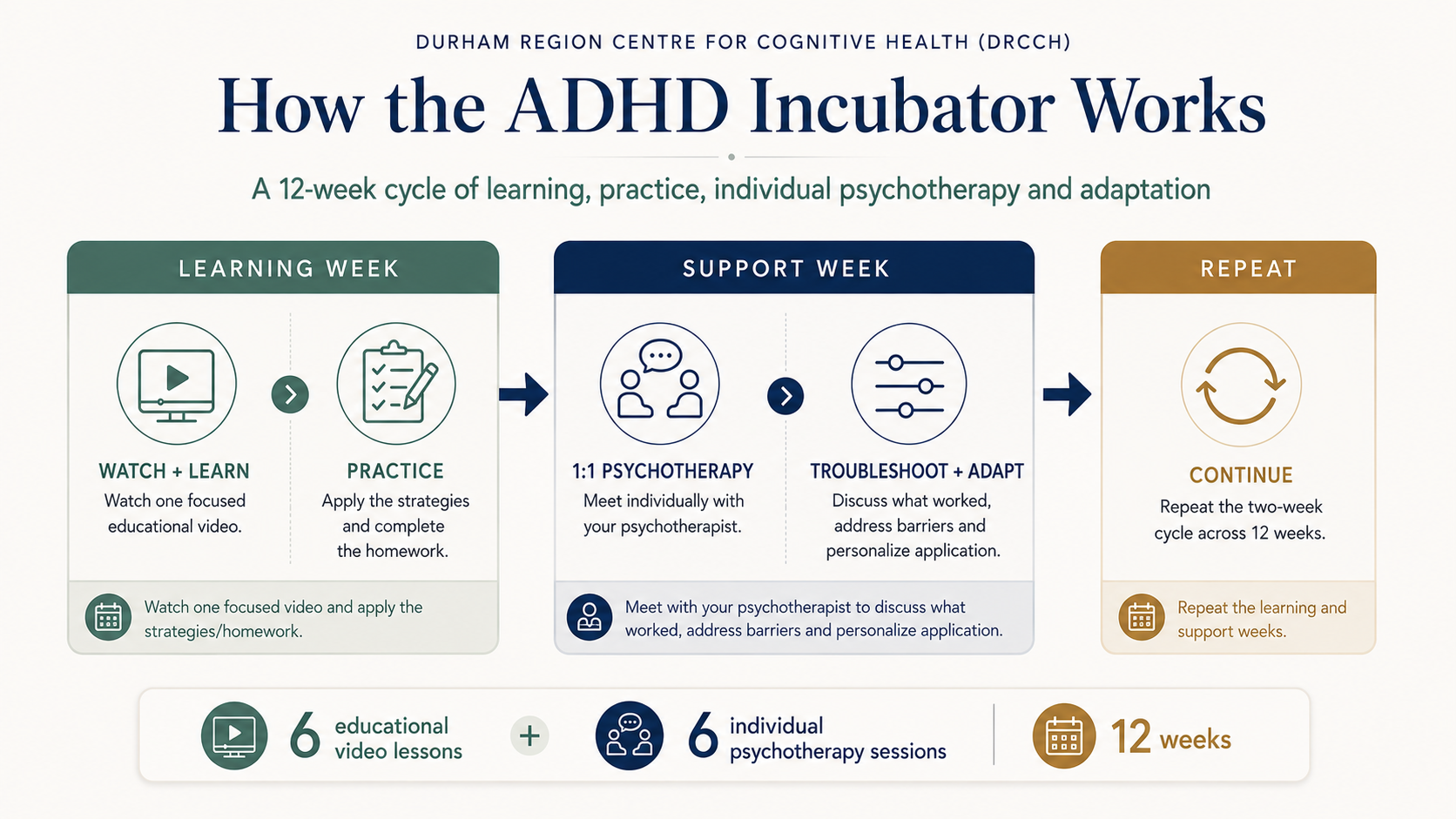
What’s Included in the ADHD Incubator
Our ADHD education helps you understand common challenges and teaches practical strategies you can use every day.
6 Educational Video Lessons

You will meet one-on-one with your psychotherapist to address challenges, tailor strategies to your needs, and get support as you put them into practice.
6 Individual Psychotherapy Sessions

You will learn practical tools to manage ADHD challenges and practice using them in your daily life.
Practical ADHD Strategies

In your individual sessions, you can work through what isn’t working, adjust your strategies, and get ongoing support as you build new skills.
Personalized Support & Accountability

CHOOSE YOUR STARTING POINT
Which Area Would You Like to Work On?
Start with the area that is creating the most difficulty in your everyday life.
You don’t need to work on everything at once.
Strong emotions can make it harder to pause, respond intentionally, and move forward after frustration or setbacks.
Emotional Regulation
Healthy Habits & Routines
ADHD can make it difficult to build routines, follow through consistently, and turn good intentions into habits that last.
IS THE ADHD INCUBATOR RIGHT FOR YOU?
The ADHD Incubator May Be a Good Fit If You…
Understanding your challenges is one thing. Building consistency around them is another.

Know the Strategies, But Struggle to Use Them

You know what could help, but it’s hard to use these strategies regularly in your daily life.
Have Trouble Following Through

You often begin with good intentions, but it’s tough to keep up routines, habits, or strategies for long.
Strategies Don’t Seem to Stick

You need support to figure out what’s holding you back and to adjust strategies so they work for you.
Want Individual Support

You’d like to work one-on-one with a psychotherapist as you build practical ADHD skills.
A Structured 12-Week Program With Individual Support
WHAT TO EXPECT

During these 12 weeks, you will complete six ADHD education modules and have six individual therapy sessions. This gives you time to learn, practice, and adjust strategies for your daily life.
12 Weeks
A set timeframe that lets you learn new strategies and try them out in your daily routine.
6 Educational Video Lessons
Each lesson covers ADHD topics and gives you practical strategies to use between sessions.
6 Individual Sessions
You will have one-on-one therapy to help you overcome challenges, tailor strategies to your needs, and stay on track.
EMOTIONAL REGULATION
When Emotions Feel Harder to Manage
ADHD can make feelings like anxiety, frustration, anger, or sadness feel stronger, and it can be harder to pause before reacting. Our Emotional Regulation program is a 12-week course designed to help you notice your patterns and respond more calmly, right when it matters most.
A small setback can feel much bigger than it should.

This May Be a Good Fit If…
Emotions Can Escalate Quickly
Small frustrations or disappointments can sometimes lead to much bigger emotional reactions than you expect.
You React Before You Have Time to Pause
Strong emotions might make you react on impulse, shut down, or respond in ways you wish you could change afterward.
Hard feelings can show up out of nowhere and get in the way of your relationships, responsibilities, or daily life.
Anxiety or Sadness Can Feel Overwhelming
You are looking for practical ways to understand what triggers strong emotions and how to respond with more awareness and control.
You Want Better Ways to Handle Emotional Triggers
What You’ll Work On
You’ll learn to understand your emotional patterns and find practical ways to handle tough emotions with more awareness and purpose.
You’ll figure out what usually triggers feelings like anxiety, frustration, fear, anger, or sadness, and start to notice the patterns in how you react.
Understand Your Emotional Triggers

You’ll learn ways to handle situations that make you feel overwhelmed, want to avoid things, or react on impulse, so you can respond more calmly and on purpose.
Manage Difficult Emotions

Build Emotional Resilience

You’ll practice skills to help you stay present and react less strongly to emotions, making it easier to handle tough situations in daily life.
EMOTIONAL REGULATION PROGRAM
Build Skills for Managing Difficult Emotions
This 12-week program helps you understand your emotional patterns and find practical ways to handle anxiety, frustration, fear, anger, and sadness.
Each week, you will follow a structured plan to build your emotional regulation skills.
12 Weeks
$316 every two weeks
Six payments over the 12-week program. $1,896 total.
You will get six one-on-one psychotherapy sessions, cognitive training tools, a private summary and strategy session with Dr. Murray, and lifetime access to the final public version of the program.
What’s Included
HEALTHY HABITS & ROUTINES
When Starting Is the Hardest Part
But twenty minutes later, you’re still looking at a blank screen. This isn’t about willpower. ADHD makes it hard to get started, not just to finish. The Healthy Habits program is a 12-week course designed to help you figure out what’s really holding you back and create routines that work in real life.
You know the task. You've even sat down to do it.

This May Be a Good Fit If…
You may know what needs to be done but still struggle to begin, especially when a task feels overwhelming, unclear, or difficult to organize.
Getting Started Feels Hard
You put things off until the pressure builds, then find yourself rushing, catching up, or struggling to finish.
Procrastination Keeps Taking Over
Organization, planning, and keeping up with responsibilities can turn seemingly simple tasks into much bigger projects.
Everyday Tasks Feel Overwhelming
You Have Trouble Following Through
You may start with good intentions but struggle to maintain routines, complete tasks, or consistently use the systems you create.
What You’ll Work On
Understand the patterns that contribute to procrastination and task paralysis, and develop practical strategies for getting started, staying organized, and following through more consistently.
Get Unstuck and Start Tasks

Figure out what leads to task paralysis and procrastination, and try out strategies that help you turn your intentions into action.

Build More Effective Systems
Find simple ways to plan, organize, and manage your work that fit easily into your daily routine.
Learn how to keep up your momentum, finish tasks, and set routines you can stick with even after the program ends.
Strengthen Follow-Through

HEALTHY HABITS PROGRAM
Build Systems That Make It Easier to Get Things Done
This 12-week program helps you tackle procrastination, task paralysis, and trouble staying motivated. You’ll learn practical systems you can keep using long after the program ends.
You’ll get structured support and build new skills throughout the program.
12 Weeks
$316 Every Two Weeks
Six payments over the 12-week program. $1,896 total.
What’s Included
You’ll receive six one-on-one psychotherapy sessions, cognitive training tools, a private summary and strategy session with Dr. Murray, and lifetime access to the final public version of the program.
Want to Learn More About ADHD Treatment Options?
ADHD treatment may involve medication, therapy, behavioral strategies, coaching, and structured support. To find out more about the research behind these methods and how they can work together, check out our guide to ADHD treatment options for adults.
QUESTIONS ABOUT THE PROGRAM?
Frequently Asked Questions
-
Each program runs for 12 weeks. You alternate between watching a short educational video one week and having an individual psychotherapy session the next, so you learn a strategy one week and use it the following week.
-
Emotional Regulation helps you manage strong emotions like frustration, anxiety, and anger, especially when they feel overwhelming. Healthy Habits supports you in starting tasks, staying organized, and keeping up with routines. Some people need just one program, while others benefit from both, though not at the same time.
-
We offer a free 15-minute phone consultation to discuss your current challenges and help you decide where to begin.
-
Each program runs for 12 weeks.
-
You receive six psychotherapy sessions, cognitive training tools, a private summary and strategy session with Dr. Murray, and lifetime access to the final public version.
-
You’ll make six payments of $316, billed every two weeks during the 12-week program, for a total of $1,896.
-
Yes, everything is online. The video lessons are self-paced, and you’ll have psychotherapy sessions every two weeks to help you stay supported and on track.
-
After you sign up, you’ll get an email with instructions to book your first session and access your first video lesson, so you can start right away.
-
No, you do not need a formal ADHD diagnosis to join the ADHD Incubator. If you are not sure whether ADHD is part of the challenges you are facing and want more clarity, you can find out more about our ADHD assessment services.
READY TO TAKE THE NEXT STEP?
You Don’t Have to Figure Out the Next Step on Your Own.

If you think the ADHD Incubator could be the support you need, reach out to us. We’re here to answer your questions and help you see if the program is right for you.